Almost nobody who searches this has been anywhere near Vodou.
My name is Ren Kagetsuki. That is not a correction and it is not me telling you nothing is happening. Something is on you or you would not be awake reading this.
It is that the word you have reached for and the thing that is actually on you are two separate questions, and only one of them affects the removal.
Where the word came from
Write down how voodoo entered your thinking. There are three routes and it is always one of them.
Someone said it to you. A reader, a relative, a neighbour, a person who wanted you frightened.
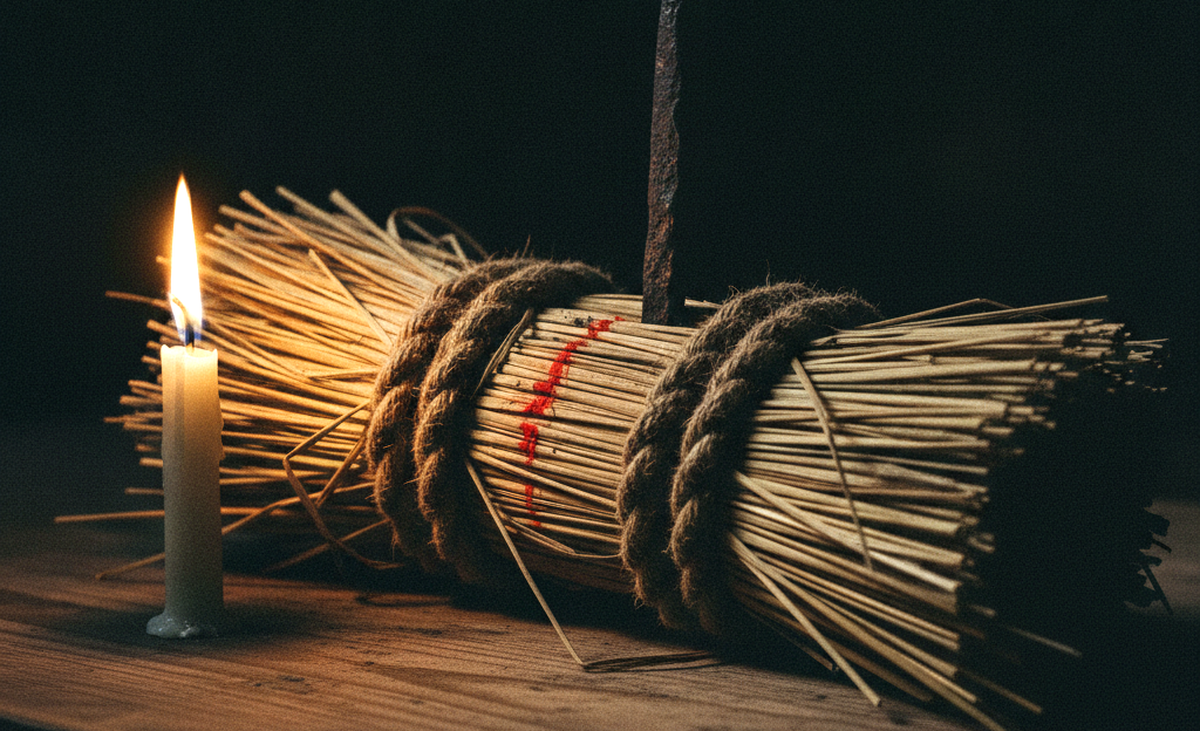
You found an object. A doll, a bundle, a knot of cloth, a bottle, something at your door or pushed under a seat.
You went looking for a word. The trouble started, you needed a name for it, and this was the name the world offered.
The third is the commonest by a long way, and it is the one to be gentle with yourself about. English hands people this word for anything aimed and foreign and frightening. That is a fact about English, not a fact about you.
What Vodou is, and why I will not speak for it
Vodou is a religion with priests, an initiation, ancestors, and a congregation. Most of what its houngan and mambo do all week is healing, counsel, and the dead.
I do not practise it. I am not initiated into it and I will not pretend to read its interior for you.
My tradition is Japanese and my training was in something else entirely. I spent fifteen years placing curses before I stopped, and what I learned in those years was not any one religion’s inventory. It was the shape a working takes once it has left the person who made it.
That shape is what I read, and it does not carry a passport.
If you have found an object
This is the one situation here that has its own procedure, so do it tonight.
- Do not touch it with bare skin. Use a cloth, a bag turned inside out, a dustpan.
- Do not open it, unpick it, or take it apart to see what is inside. Do not photograph it and send the picture to people.
- Do not burn it. Burning is an act aimed at whoever made it, and it will be received that way.
- Wrap it in white cloth or plain paper, with a good handful of coarse salt inside the wrapping.
- Get it out of the building the same night. Into the ground away from your home if you have somewhere. If you have no garden, and most people do not, sealed in a bag into a public bin two or more streets away, on your way somewhere else. Do not carry it back past your own door.
- Salt in both palms under running water when you get home, wrists and up to the elbows, rinsed downward.
An object placed where you will find it is doing two jobs. One of them is the working. The other is that you were meant to find it, and that half of it stops the moment the thing is out of your house.
Voodoo curse removal is the same removal
People write to me expecting to be turned away because they think their case needs a specialist in the tradition that was used.
It does not, and here is why.
A tradition supplies the language, the materials, and the beings appealed to. Once the thing is on a person it is a line running from an anchor to a body, and a line has no dialect. It has a weight, a direction, an age, and a point of attachment.
Those four are what the reading gets, and those four are what the work acts on.
The sequence is the same one I use for anything aimed. Read it, clear what has settled, turn it, return it to where it came from, cut the line, seal the route so the same anchor cannot be used twice. It is described in full here: the order the work is done in.
Stopping at the clearing is the mistake. The clearing takes the weight off for a fortnight and the line is still attached.
The clearing you can do while you wait
Coarse salt in a hot bath, fifteen to twenty minutes, rinsed off from the head down. No bath is not a problem, and most of the world does not have one. Salt in a bowl of hot water poured over the shoulders, or worked in wet palms over the neck and wrists, always rinsed downward.
Then coarse salt dry-fried in a pan for five minutes until it stops crackling, in two small cones by your door, changed each morning.
Three nights of that will tell you something useful. If it lifts and stays lifted, what you had was residue. If it lifts and comes back, the line is still there, which is the answer most people get.
What to tell me
Not the tradition. I do not need you to have identified it and a wrong guess does not cost you anything.
When it started. Which single part of your life is taking the weight. Whether anything was found, and where. Whether anyone has a reason.
It is carried out from here, with nothing required of you and no contact with anybody at all: what the work involves.
You came here with a word that may be the wrong one. The thing underneath it is not wrong, and that is the part I work on.